
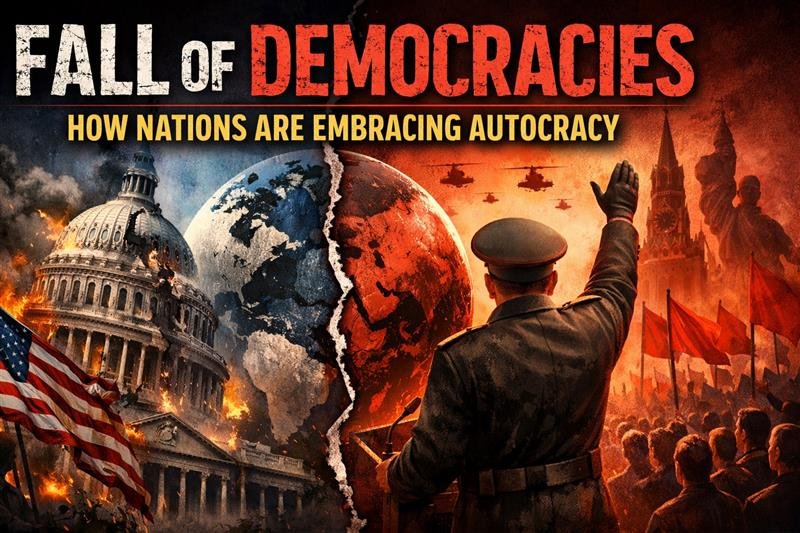
Over the past decade, the world has witnessed a dramatic shift: democracies are increasingly giving way to authoritarian regimes, spanning communist, dictatorial, and hybrid systems. From Europe to Asia, and the Americas to Africa, democratic institutions are weakening under the weight of populism, polarization, and institutional erosion. This article explores the major forces driving this transition, offers country-specific examples, and highlights potential strategies for reclaiming democracy.
1. The Global Decline of Democracy
Persisting Global Downtrend
- The International Institute for Democracy and Electoral Assistance (IDEA) reports a ninth consecutive year of democratic decline in 2024: out of 173 countries, 94 experienced deterioration in at least one democratic dimension, such as representation, rule of law, and civil liberties. Only 55 made improvements.
- The Economist Intelligence Unit’s Democracy Index (2024) reached its lowest average since measurement began, with over a third of the global population under authoritarian rule.
- V-Dem data highlights 25 years of accelerating autocratization across the globe, marked by growing attacks on freedom of expression.
2. Root Causes of Democratic Erosion
2.1 Populism and Authoritarian Leaders
Authoritarian populists exploit fear and frustration, framing politics as “us vs. them”, usually pitting a virtuous “people” against corrupt elites. These charismatic leaders often weaken democratic institutions through legislative capture and executive overreach.
2.2 Economic Inequality
High inequality weakens trust in institutions and fuels resentment. A major study found it’s among the strongest predictors of democratic erosion, even in longtime strong democracies.
2.3 Institutional Capture
Backsliding often occurs gradually via legal manipulation by executives or legislatures that erode checks and balances in subtle, “legal” ways, leading to consolidated power.
2.4 Weakening of Free Press and Civil Liberties
Journalistic freedom is plummeting: between 2019 and 2024, 43 countries saw major declines, the worst in five decades. Closed civic space hinders accountability and enables regimes to govern unchecked.
3. How Democracies Shift Toward Authoritarianism
- Electoral Manipulation: Redrawing electoral districts, limiting opposition campaigning, or rigging elections.
- Constitutional Amendments: Using referendums or legal reforms to extend power or weaken oversight.
- Legislative Capture: Gaining control over legislatures to pass authoritarian-leaning laws.
- Suppressing the Media: Curtailing freedom through censorship, surveillance, or regulatory constraints.
- Political Intimidation: Harassing opposition, NGOs, and academic institutions to stifle dissent.
V-Dem identifies distinct autocratization patterns: stand-alone autocratization, when democratic norms are individually degraded; and “bell-turn” autocratization, where a reformist regime suddenly shifts authoritarian.
4. Country Profiles: From Democracy to Dictatorship
4.1 Hungary
Under Viktor Orbán, Hungary has dismantled structural protections: the government exercises vast control over media, judiciary, and electoral processes, a textbook example of democratic capture.
4.2 Turkey
President Erdoğan systematically eroded opposition by purging the judiciary, muzzling press, and skewing electoral oversight, transitioning Turkey toward a centralized, executive-dominated regime.
4.3 Brazil
Jair Bolsonaro’s populist wave in Brazil saw the delegitimization of democratic checks. Institutional safeguards came under fierce political assault, though recent elections show domestic resilience.
4.4 India
Traditionally strong democratic norms in India have come under strain: attacks on press freedom, civil society, and judicial autonomy signal a trend toward illiberal governance.
Since Narendra Modi assumed office in 2014, India’s democratic framework has faced significant strain. While elections continue to occur, the essence of liberal democracy, free press, independent institutions, and civil liberties, has been steadily eroded. This transformation has been gradual, making it harder for citizens to recognize the depth of change.
4.4.1 Curtailment of Press Freedom
One of the most visible signs of democratic decline is the shrinking space for independent journalism. India’s press freedom ranking has fallen sharply in recent years. Investigative journalists and media houses critical of the government have faced raids, tax investigations, and legal harassment. Prominent cases include the freezing of funds for independent outlets and the arrest of journalists under stringent laws like the Unlawful Activities Prevention Act (UAPA). Corporate acquisitions of major media networks by business groups aligned with the ruling party have further compromised editorial independence, creating an environment where dissenting voices are marginalized.
4.4.2 Weakening of Institutions
Democracy thrives on checks and balances, but under Modi, these safeguards have weakened. The judiciary, once a robust pillar, has faced allegations of selective appointments and pressure in politically sensitive cases. Parliament has witnessed a decline in deliberative processes, with major bills passed without adequate debate or consultation. Opposition leaders have been targeted through investigative agencies, raising concerns about the misuse of state machinery for political gain.
4.4.3 Erosion of Civil Liberties
Civil society organizations have been systematically constrained through restrictive laws such as amendments to the Foreign Contribution Regulation Act (FCRA), which limit foreign funding for NGOs. Many advocacy groups working on human rights and environmental issues have been forced to shut down. Simultaneously, laws like sedition and anti-terror provisions have been used to silence activists, students, and critics, creating a climate of fear and self-censorship.
4.4.4 Rise of Majoritarian Politics
The Modi era has seen an increase in religious polarization. Hate speech and discriminatory policies have targeted minority communities, particularly Muslims. Incidents of mob violence and property demolitions have occurred with little accountability. This majoritarian approach undermines the secular foundation of India’s democracy and threatens equal citizenship.
4.4.5 Centralization of Power
Modi’s leadership style emphasizes strong central control, reducing the autonomy of states and bypassing institutional checks. Decision-making has become highly centralized, with key policies announced without prior consultation. This concentration of authority diminishes the role of democratic institutions and fosters a personality-driven governance model.
India remains an electoral democracy, but its liberal democratic character has weakened considerably. Press freedom, institutional independence, and civil liberties have all declined, while majoritarian politics and centralized power have gained ground. If these trends continue unchecked, India risks transitioning from the world’s largest democracy to a hybrid regime where elections exist but genuine democratic freedoms do not.
4.5 United States
Once considered a full democracy, the U.S. now navigates the troubled waters of a “flawed democracy”, deep polarization, repeated government shutdowns, and challenges to electoral integrity mark this period.
4.6 Poland
Under the Law and Justice Party (PiS), Poland witnessed judicial and media capture. Despite setbacks, a recent electoral shift signals potential democratic recovery.
4.7 Africa & Asia
Countries like Zambia, Senegal, Ethiopia, and Myanmar demonstrate varied trajectories, some edging toward authoritarian rule, others pushing back toward democracy.
5. Why This Matters
- Civil Rights Under Threat: Declining democracies often experience rising repression, restricted freedoms, and weakened civil society.
- Regional Instability: Aggressive authoritarian neighbors, such as Russia or China, embolden democratic rollback in adjacent states.
- Global Governance Impact: Weak democracies undermine international cooperation on climate, public health, trade, and peacekeeping.
6. Reversals and Recoveries
Some nations are reversing democratic backsliding:
- Poland, Brazil, Zambia, Senegal, and Thailand have made notable democratic gains via voter mobilization, strong civil society, and revitalized institutions.
- Scholars emphasize that broad public engagement, vigilant media, cohesive opposition, and independent judiciaries are key to democratic resurgence.
7. Pathways to Strengthen Democracy
| Action Area | Key Measures |
|---|---|
| Electoral Integrity | Transparent elections, independent election commissions, international observers |
| Judicial Independence | Firewalls insulating courts from political interception |
| Media Freedom | Protecting press rights, repealing restrictive media laws |
| Civil Society | Legally enabling NGOs, grassroots initiatives |
| Economic Equity | Progressive tax systems, social safety nets to reduce inequality |
| Public Awareness | Civic education and democratic values training |
Suggesting coordinated global, regional, and local efforts is essential to defend democracy. Empowering institutions and informed citizenries is critical to maintaining balance and preventing authoritarian ascent.
Conclusion
The global decline of democracy reflects a complex intersection of economic, political, and social pressures. Populist leaders, inequality, institutional capture, and media suppression are key forces eroding democratic norms. Yet, examples from Poland to Zambia underscore that democracy can rebound when citizens, institutions, and civil society unite. Proactive measures, spanning the electoral, judicial, economic, and cultural spheres, are urgently needed to preserve democratic governance in the 21st century.
